
Lead tracking involves monitoring how leads engage with your brand from the moment they first come into contact with your business to when they finally convert into customers.
Without effective tracking of leads, it becomes difficult for your business to know which leads convert best and identify leaks in your sales funnel where most of the leads drop off. You also lose out on opportunities to streamline your sales funnel to convert more leads and cut down the sales cycle.So, what does effective lead monitoring or tracking look like? This article will cover lead management and share the five best practices for tracking leads efficiently. We’ll also show you a solution that can upgrade your lead monitoring efforts, such as LeadsBridge CRM Lead Sync features.


What is lead tracking, and why is it important
Lead tracking is the process of monitoring how leads or potential customers interact with your sales and marketing touchpoints. This process helps you identify who your leads are, where they come from, how they engage with your sales and marketing materials, and how they end up converting into customers.
Effective lead tracking is extremely important for businesses. Brands spend thousands of dollars on lead generation. For context, channels like PPC and tradeshows have a cost-per-lead of up to $181 and $811, respectively, according to a report by HubSpot.
Besides showing how leads convert into paying customers, an effective tracking system will also show you where leads drop off from your sales funnel.
Here is why this process is so important:
- Shows you where to invest – Effective tracking highlights the key customer touchpoints and interactions. Those insights help you know the effectiveness of your sales and marketing efforts and pinpoint opportunities for improvement.
For example, the process highlights lead sources. That could be Google ads, email, social, search, or referral. Knowing where most of your leads (quality leads) come from shows you the channels that work for your brand so you can double down on those efforts.
The HubSpot report above shows email has one of the lowest CPLs at $53. That should encourage you to invest in a solution like GetResponse to create an email newsletter for your brand.
That said, you will only know what channels actually move the needle for your brand when you track your leads effectively. - Helps you speed up the sales cycle – efficient tracking of leads shows the actions leads take when interacting with your brand. What forms do they fill out? Do they download specific resources? What pages do they interact with?
These interactions are critical in identifying what resonates with potential customers. It can also show you the customer journey or path that leads take from first contact to booking a demo or signing up for your solution.
Understanding this path can help you speed up the sales process as it allows you to anticipate customer behavior and respond in a timely manner. - Tracking leads will also require you to keep track of critical lead data and metrics – You’ll need to monitor cost-per-lead, cost-per-acquisition, time to conversion, and lead-to-customer conversion rate by campaign and source.
You can also track landing page conversion rates as an additional metric to see which campaigns are driving leads most effectively. Use these insights to inform your marketing and sales efforts and optimize your ROI.
For example, tracking lead-to-customer conversion by campaign can show you which campaigns work best.
Similarly, tracking lead-to-customer conversion by lead sources tells you the sources that don’t just generate the most leads, but the best leads with high conversion rates.

5 best practices for tracking leads efficiently
Here are the five best practices you must follow for effective lead management and tracking.
1. Lead gathering and segmentation
Lead capturing is the first step of the lead management process. This step is usually followed by segmentation, which is where you place leads into different groups based on a predefined criterion.
To streamline your lead gathering and segmentation process, start by standardizing your lead capture forms. Ideally, you want to avoid asking for too much information in your capture forms. A high number of form fields reduces the form completion rate.
Start by asking for basic information like name and email address. For B2B businesses, asking for additional details like role and company size is standard practice. That works especially well when you’re using original research as lead magnets.
For example, GetResponse uses an insightful ebook on how to build customer relationships with email marketing as a lead magnet to capture additional lead data like phone number, website URL, and country.

You can enhance this data further with a lead enrichment solution.
Don’t forget to tag your leads with critical data like lead source as you enrich the data. Use UTM parameters to capture source, campaign, channel, and term. That ensures every lead can be linked back to the specific page, ad, or email campaign that brought them.
You’ll need a CRM solution for this. We’ll talk about using a CRM system for tracking below.
Segmentation is the other process you must enhance to ensure effective lead monitoring. Avoid creating too many segments, as it can mess up reporting and confuse your marketing and sales teams.
Instead, identify up to four compelling segments that tie back to intent or company profile.
For example, you can use automated lead scoring to create two lead segments of high-intent and low-intent leads. This makes it easier for your sales teams to know which leads to focus on for conversions and which ones require additional nurturing.
Review your segments regularly to confirm if they still serve their purpose.
2. Qualify the leads
Lead qualification shows which leads meet your organization’s ICP. When combined with lead scoring, this process helps your sales team know where to pour their resources when they need to close deals vs where more lead nurturing is required.
Start by defining who a qualified lead is for your business. Both the marketing and sales teams should have the same definition of a qualified lead. That makes sure that marketing teams bring in leads your sales team can actually convert into customers.
Next, you must track the best leads that convert. What channels did they come through, and what path did they follow? What common attributes do they have?
For example, are they all from a company with a particular profile (e.g., has a certain number of employees, located in a certain area, belongs to a specific industry, etc)?
You can even go as far as tracking the LTV of those leads. That data will help you identify your best leads. And once you know who they are and you have qualified them as specific audiences in your CRM, your marketing teams can work on targeting those types of leads since they’re proving to be your best customers. With LeadsBridge integrations for audience targeting, you can do i automatically by connecting your CRM with the main advertising platforms.


Use lead qualification alongside automated lead scoring to ensure qualified leads are routed to your sales team automatically. This adds efficiency to your sales process. Tracking the path customers take before converting should help you identify the key actions in the customer journey. Use these actions to score the leads, as shown in the lead scoring model below.

The best CRM systems let you set customer behavior or actions (e.g., downloading a lead magnet, requesting a demo, etc) and their corresponding scores. The leads will then be routed to specific sales team members when they hit a set score.
3. Opt for a CRM system
CRM lead tracking brings efficiency to your process through automation.
CRM systems support automation of critical lead monitoring functions. For example, these systems can help you tag lead sources automatically. They also support lead scoring and ensure that sales-qualified leads are always routed to relevant sales reps.
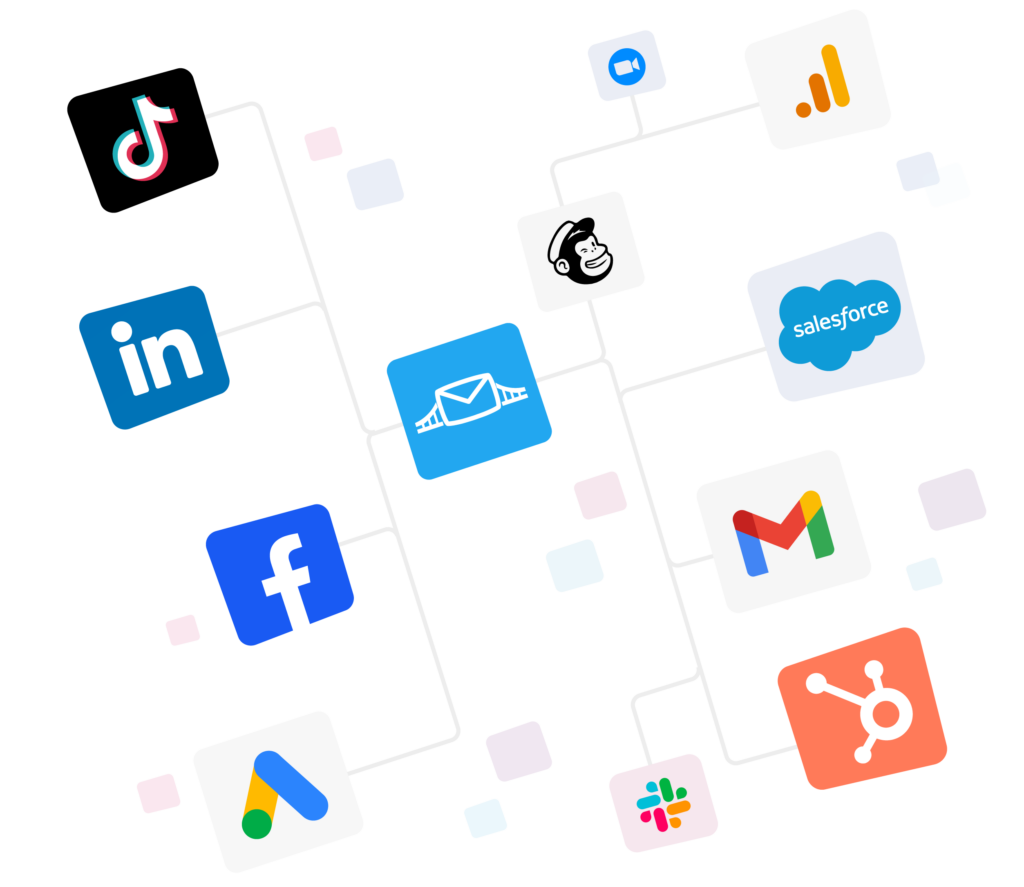
The best CRM for tracking leads also provides powerful analytics. It’ll help you keep track of the critical metrics we mentioned earlier, like lead-to-customer conversion rates by campaigns and sources. That’s where integration with your existing tech stack becomes critical. For example, a solution like LeadsBridge helps you sync data from critical channels, such as LinkedIn lead gen forms, Facebook lead ads, and Google lead ads, with your CRM.


Besides eliminating manual CSV file uploads, LeadsBridge’s real-time sync ensures your sales and marketing teams have complete visibility over all lead data. That makes for better and faster decision-making to speed up your sales cycle and improve conversion rates.
As such, make sure your CRM system integrates with critical solutions like LeadsBridge that your team will need to work smart and efficiently.
4. Set SMART goals
Effective tracking of leads requires that you set SMART goals that help you determine both the quantity and quality of leads your business generates.
While saying “we want to generate more leads in Q3” is helpful, it’s more important to refine the goal and make it Specific, Measurable, Achievable, Relevant, and Time-bound. Even more critical is moving from just “more leads” to “ more qualified leads.”
That makes sure that your business is not just obsessing over head count, but that your goals tie directly to business outcomes like revenue.
So a more helpful goal would be to “generate 100 qualified leads from LinkedIn ads in Q3, with at least 30% converting to opportunities in the sales pipeline.”
This goal is SMART and makes sure that your team doesn’t chase quantity at the expense of quality. They’ll aim to generate 100 qualified leads from LinkedIn with the objective of converting at least 30% of them to mark this goal as a success.
5. Align and train your sales and marketing teams
Sales and marketing teams must read from the same playbook if your business is to manage leads better and optimize conversion rates.
First, both teams must have the same definition of a qualified lead, as highlighted earlier. Secondly, you should work with the two teams to help them know when a lead should be handed over from the marketing team to the sales team.
In other words, at what point does a marketing qualified lead (MQL) become a sales qualified lead (SQL)?
Both teams should know and understand the definition of MQL and SQL to ensure the marketing team doesn’t drop the ball by continuing to nurture a lead who is ready to close. Or that the sales team doesn’t waste their resources on leads that are not yet ready for a sales call.
Automate the handoff process by ensuring your CRM solution alerts the sales team whenever a lead hits the threshold to become an SQL. Ideally, you should have a mandatory field that your sales team must fill within the first 24 or 36 hours of the handoff.
The field updates the lead status to show whether the sales team has made contact and the progress. That is crucial to make sure that leads are not lost during the handoff process, which can happen very easily.
Final thoughts
Effective lead monitoring makes sure that your investments in lead generation efforts result in meaningful ROI. This process will highlight channels that work, lead types that convert best, and stages in the sales funnel that could be bleeding you cash.
We’ve covered five effective ways to track leads. Ultimately, you need an effective CRM lead tracking system to implement this process efficiently. This system will level up your tracking efforts through automations and AI capabilities.
You should also look into a CRM solution that integrates with LeadsBridge. This improves tracking through automated data sync with marketing and advertising platforms like Meta, LinkedIn, Google, and TikTok. The integration allows you to track and even segment leads efficiently with the help of real-time data.