
Are you weighing Google Ads vs. Facebook Ads, and want to know what is good for your brand?
Google Ads captures demand, which means:
- It helps you target the people searching for something they want right now.
- Google gives better search-term-level targeting and reporting, plus stronger call conversions and local targeting.
Facebook is great for creating that demand:
- It lets you put the offer in front of the right people first.
- Meta’s Advantage+ Creative gives stronger in-platform AI creative variations and placement auto-adaptations.
You need leads, but you can’t afford to test every platform out there?
Choose a platform that matches your audience’s intent, aka, how ready people are to buy. Then, track results so you can focus your budget on what really works.
- Using Google Ads for small businesses: A quick checklist
- Running Facebook Ads for small businesses: A quick checklist
- Google Ads vs. Facebook Ads for small businesses
- Data integrations: How to cut costs and boost your ad performance
- A step-by-step guide: How to set up Google and Meta integrations
- FAQs
- Takeaways
This guide helps you choose the right platform and build a strategy that lets you get the most out of it.
For instance, setting up must-have data bridges to build an automated lead generation system that gets you closer to your conversion goals.


Using Google Ads for small businesses: A quick checklist
People are searching for what you sell, but you’re not showing up (or you’re paying too much).
The key to running good ads on Google is matching high-intent keywords to a landing page that answers the search.
Google has reported that 76% of people who do a local search on their smartphone visit a business within 24 hours, and 28% of those searches result in a purchase.
Here’s a quick Google Ads checklist for your ad setup:
- Pick 5–15 high-intent keywords (service, city, book CTAs, price, ‘near me’ location, etc).
- Build one landing page per offer and skip the homepage.
- Set conversion tracking before launch. These can be calls, forms, bookings, or sales.
- Start with narrow targeting by tightening the location, schedule, and negative keywords.
- Use ad assets like call and location.
- Watch your ads’ Quality Score (Google’s 1–10 relevance rating).
If you’ve just started, Google’s own small-business starter tips are worth a quick skim before you launch, especially around goals and budget setup.
Common Google Ads budget issues and how to fix them
Most of Google’s ad problems come down to paying for the wrong searches. To address this, check the Search terms report weekly and add negatives.
Broad targeting without negatives is how you can lose a chunk of your Google ad costs. So you need to work on narrowing your targeting.
Another common issue is the landing page. This happens when businesses start generating leads, but their site isn’t ready.
If that’s you, test Google lead form assets (lead forms inside the ad) so you can capture leads without relying on a perfect landing page.

Running Facebook Ads for small businesses: A quick checklist
Do your customers know you? Do you have an innovative service or product that people may not know about?
If you think you need better brand awareness for your offer to make sense, use Meta for discovery.
But you must already have a system set up to send your follow-ups quickly and consistently.
Meta reported 3.58 billion daily active users across its ‘Family of Apps’ in December 2025.

So if you know the anatomy of Facebook Ads and follow the best practices for Meta advertising, reach is not the problem.
Here’s a quick checklist of all the must-haves in your Meta ad:
- Choose one goal: Leads or Sales. Avoid Traffic unless you know your site converts.
- Pick conversion location: Instant Form (fast) or website (more control).
- Launch with 3–5 creatives for the same offer. Basically, different hooks, but the same offer.
- Use the ‘Higher intent’ Instant Form if quality matters.
- Add one qualifier question, such as timeline, budget range, or service.
- Follow up within 5–15 minutes.
Common Meta lead-quality problems and how to fix them
You are generating a good amount of leads, but they never reply. When that happens, figure out what’s wrong with your offer.
Work on your offer by running some A/B tests and switching to higher-intent forms. Meta’s help docs also stress keeping forms simple and using the right form options.

Search is still the biggest slice of digital ad revenue at 40.9%, which tells you how valuable intent is.
Learn more about Facebook ad rules here.
Google Ads vs. Facebook Ads for small businesses
If you compare clicks and feel the results don’t make sense, it’s probably because the buyer’s mindset is different.
So, compare by intent and what each platform needs to succeed.
| Factor | Google Ads | Facebook (Meta) Ads |
| Buyer intent | High: I’m looking | Medium: I’m browsing |
| Best at | Capturing demand | Creating demand and retargeting |
| What you need | Keywords and landing pages or lead forms | Creative and offer clarity |
| Common failure | Broad keywords | Slow follow-up / weak offer |
| Best early metric | Cost per qualified lead | Cost per qualified lead |
Google Ads vs. Facebook Ads for small businesses: Use cases
Starting off without any strategy or data analysis gets you nowhere. Instead, you need to match the channel to the customers’ point in their journey.
Here’s a general use case outline:
- Urgent and local services: Start with Google Search.
- Appointment businesses: Meta helps you fill the top funnel while Google targets ‘near me’ searches.
- Ecommerce: Use Meta for discovery and retargeting, and Google for active shoppers.
- B2B services: Use Meta for awareness, along with Google for comparison searches.
Google Ads vs. Facebook Ads for small businesses: How to run both
Say you’ve decided that you want both platforms. There’s always a concern about splitting the marketing budget and not getting results from any of them.
That doesn’t need to be the case, especially if you give each platform one clear job. Here’s a simple three-layer strategy to help you do this:
- Layer 1 (Meta Prospecting): This should have one offer, one audience, and 3–5 creatives. You can either optimize for leads or purchases.
- Layer 2 (Meta Retargeting): Retarget site visitors and leads who didn’t book a demo or buy. This is where Meta often outdoes itself.
- Layer 3 (Google Search): Bid on your core ‘ready now’ keywords and branded terms so you don’t lose high-intent traffic.
If you’re starting small, run Layer 3 and Layer 2 first. Prospecting is an advantage of using Meta in your marketing strategy, but it needs more creative testing. This also means more marketing dollars before you can get steady results.
Google Ads vs. Facebook Ads: How to decide which platform is best
You want to match your channel to how customers find you, then expand.
Choose Google Ads first if people already search for your service daily, and one sale can cover multiple clicks.
But go for Meta first if people discover you visually, and have your team follow up fast. Use both if your sales cycle is longer and you can track leads past form submission.
Still wondering about ad costs?
- Under $1,000 per month: Your ads should strictly have one platform, one offer, and one objective for one conversion.
- $1,000–$3,000 per month: Add the other retargeting platform.
- Over $3,000 per month: Run ads on both with one follow-up process and tracking plan.
Data integrations: How to cut costs and boost your ad performance
Without automated lead management, leads often end up in the wrong inbox, follow-up is delayed, and reporting doesn’t reflect reality.
Wondering how to reduce your ad costs? You need better ads. And that’s possible with a system that syncs leads in real time, keeps audiences up to date, and sends conversions back to ad platforms.
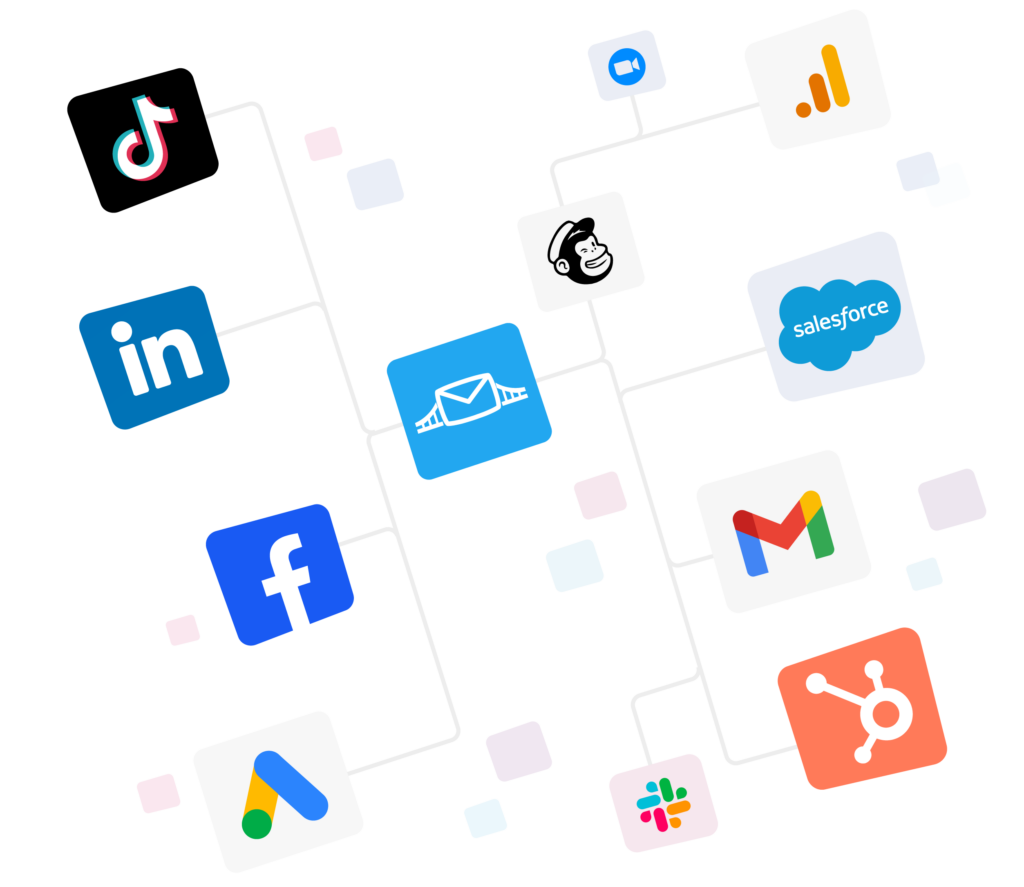
LeadsBridge offers over 390 integrations that connect Google and Meta to CRMs and marketing tools, including lead sync, audience updates, and conversion-tracking workflows.

A step-by-step guide: How to set up Google and Meta integrations
Manual data transfer makes your lead wait (which significantly lowers conversion rates), doesn’t update your database, feeds outdated data to platforms, and takes up a massive amount of time and energy.
For each platform, you need to build three connections:
- Incoming leads to your CRM
- CRM segments to your audiences (custom or Matched)
- CRM conversions and closed deals back to ad platforms
Here’s how:
Step 1: Define your funnel events
Lead (form or call), Qualified, Won.
Step 2: Lead Sync setup
Go to the LeadsBridge dashboard. Log in first or create an account for free. Then create a new bridge:
- Source: Facebook lead ads or Google lead form assets.
- Destination: Your favorite CRM or email tool.
- Map fields (name, email, phone, campaign), then test a real submission.
- Save & publish your bridge.


This guide is valid for any other bridge you want to set up.
Step 3: Audience Sync data flows
- In your CRM, build lists for new leads, customers, and no-shows.
- Connect your data via integrations to Meta custom audiences and Google Customer Match.


- Then create retargeting campaigns for warm leads. You always need to exclude your existing buyers, which requires up-to-date data and continuous feedback to the platform you are retargeting on.
Step 4: Conversion Sync
Send Booked or Won segments back to Meta via Conversions API so Meta’s algorithm can train and optimize for better leads.


Step 5: Audit
Compare leads reported vs. leads received to catch gaps before you scale.
FAQs
1. Google Ads vs. Facebook Ads for small businesses: Which works best?
The best platform for you is the one that closely matches the intent of your buyer. If customers search with clear intent, Google usually wins. If customers need to be convinced, Meta often wins. Using both is common for longer sales cycles.
2. Do Google Ads work for small businesses?
Yes, Google Ads work if you stay narrow and track conversions. Learn more about how Google Ads works for small businesses.
3. Do Facebook ads work for a small business?
Yes, Facebook Ads perform really well if you control lead quality and follow-up speed (higher-intent forms help). Discover everything you need to know about whether Facebook Ads work for small businesses.
Takeaways
Are you ready to run ads? You’ll know you are ready when you’ve created a strategy and a toolkit that makes sure you don’t have to download and upload any data manually.
Automation in lead capture and lead management used to be an innovative solution, but now you simply cannot compete in the fast-paced market.
LeadsBridge offers integrations that help your leads, audiences, and conversion tracking stay synced automatically.
Discover all the Google Ads integrations.
Check out all the possible Facebook integrations.