
TL;DR
- Most agencies lose new business because their audience targeting is too vague.
- A target audience for an agency is a specific combination of firmographic, demographic, behavioral, and psychographic signals. What it is not is a job title and an industry vertical.
- In 2026, the best way to define it is by looking at closed-won customers, tracking intent signals, and using first-party data from your site and campaigns.
- Segmentation then breaks that audience into useful groups by funnel stage, urgency, channel, and role, so you can personalize your outreach.
- LeadsBridge keeps your agency’s audience segments synced across CRM, landing pages, and ad platforms in real time.
Who are you really trying to reach with your marketing?
If your answer includes several categories at once, your agency has a problem. Your target audience is too broad.
A vague audience results in running weak campaigns. It affects your client work, but also your own agency marketing: sales pipeline, LinkedIn content, paid ads, and email outreach.
As an agency, you need to define your target audience with data. The best agencies apply the same level of precision to their own marketing that they use for client campaigns.
- TL;DR
- Target audience for a digital marketing agency explained
- How to define your digital marketing agency’s target audience
- How to define the digital marketing agency’s target audience segments
- How to activate your digital marketing agency’s target audience through channels
- Digital marketing agency target audience: FAQs
- Takeaways
In this article, we’ll cover what a target audience means for a digital marketing agency, how to define and segment it in 2026, and how to activate it across channels with the right marketing automation tools.


Target audience for a digital marketing agency explained
A target audience is the group of businesses or decision-makers most likely to hire your agency, pay a profitable fee, get strong results, and stay long-term.
It’s more specific than saying anyone who could use your services.
The right digital marketing agency target audience segments can:
- Afford you
- Understands the problem you solve, is either actively looking or open to being reached
- Fit the kind of work your agency does best
For agencies, this goes beyond demographics. You’re looking at company size, industry, revenue, growth stage, buying behavior, tools they use, content they read, and how they think about marketing investment.
Most marketers are putting about 40% of their budgets into personalization, up from 22% the year before. Still, 57% say audience segmentation is one of their biggest challenges, often because they’re not fully using the customer data they already have.
How to define your digital marketing agency’s target audience
Defining your target audience helps you focus on the clients most likely to buy, stay, and grow with you.
The clearer your audience, the easier it becomes to sharpen your positioning, personalize campaigns, lower acquisition costs, and build a pipeline that actually converts.

Here are four ways you can do that:
1. Start with your closed-won clients
Before doing market research, look at the clients you’ve already won, especially the ones who stayed, paid on time, trusted your work, and got results you can actually talk about.
Look for patterns in industry, company size, revenue, location, growth stage, main marketing problem, channels they were using, and how they found you.
Your best clients are your clearest signal. If most of them are B2B SaaS companies with 50–200 employees running LinkedIn ads, that’s probably where your agency likely creates the most value.
2. Track intent signals
Closed-won data shows who hired you. Intent data shows who may be getting ready to buy.
In 2026, tools like G2, Bombora, LinkedIn, and Similarweb can help agencies spot companies researching services like SEO, paid media, or agency marketing automation before they submit a form or ask for a proposal.
You can also watch for signals like rising ad spend, new marketing hires, software adoption, or increased content engagement. These clues help you find prospects.
3. Find gaps in competitor audiences
Study your competitors’ case studies, testimonials, LinkedIn posts, and client logos. Look at who they clearly serve, then look for valuable groups they are ignoring.
A financial services lead gen agency has a sharper position than a general agency with a mixed portfolio. The specialist earns trust faster, has stronger proof, and can usually charge more.
The goal is to find an audience segment where you can be more relevant than everyone else.
4. Use your own behavioral data
Your website, landing pages, emails, ads, and LinkedIn content already show who is paying attention.
A lead generation best practice is to look at:
- How your pages drive form fills
- The rate of emails that get replies
- The posts bring qualified DMs
- The messaging and offers that attract the right companies
Once you have your results, compare that behavior against your ICP. If your best-fit prospects keep engaging with one service, channel, or use case, that’s where your targeting and content should focus.
First-party data is also your strongest long-term signal.
Learn how to run ads on Meta for your clients here.
How to define the digital marketing agency’s target audience segments
Once you know your target audience, segmentation turns that audience into groups you can actually market and sell to.
The best audience segments for a digital marketing agency usually come from four areas:
- Funnel stage:
Someone who visited your pricing page twice, downloaded a case study, and opened several emails is much warmer than someone who clicked one LinkedIn ad. They need different messaging and follow-up at different stages.
- Firmographic profile:
Company size, industry, revenue, and growth stage affect budget, buying process, and sales cycle. A 15-person startup and a 500-person enterprise may both fit your ICP, but they need different offers, proposals, and onboarding.
- Decision-making role:
The CEO or CMO cares about ROI and budget. The marketing manager cares about vendor fit and execution. The person working with your agency day to day cares about process, speed, and support. Each role needs a different message.
- Behavioral signal:
Your leads and prospects’ actions show their intent. Managing your lead tracking means following the intent. For example:
- Pages prospects visit
- Case studies they download
- Ads they click
- Webinars, pricing pages, or demo forms, they engage with
When these segments are built into your CRM, you’ll have campaigns that match the right message to the right buyer.
How to activate your digital marketing agency’s target audience through channels
What’s the first step in finding a high-quality target audience for a digital marketing agency? Defining your audience.
Here’s how to turn your segments into campaigns that actually reach, convert, and retain the right prospects.
| Activation step | What to do | Why it matters |
| Sync CRM audiences | Connect CRM segments to Meta, LinkedIn, Google, and TikTok in real time. | Keeps targeting accurate and avoids outdated audience lists. |
| Match targeting to each platform | Use LinkedIn for precise B2B roles and Meta for broader behavioral targeting. | Helps each channel do what it does best. |
| Follow up instantly | Send lead form submissions straight into your CRM and workflows. | Prevents delays and improves conversion chances. |
| Send conversion data back | Push closed deals or qualified leads back to ad platforms. | Trains algorithms to optimize for revenue, not just form fills. |
| Keep suppression lists clean | Automatically remove clients, churned accounts, or bad-fit leads from the wrong campaigns. | Saves budget and avoids awkward targeting mistakes. |
| Create segment-specific content | Write for clear audience groups, not broad generic audiences. | Attracts better-fit prospects who recognize their exact problem. |
| Score and route leads | Use CRM rules to qualify, tag, and assign leads by fit and urgency. | Gets high-value prospects to the right follow-up faster. |
| Review performance quarterly | Check conversion rate, deal size, time-to-close, retention, and channel results by segment. | Keeps targeting based on current data, not old assumptions. |
1. Sync CRM audiences with ad platforms in real time
Your CRM knows who is a warm lead, current client, churned client, or proposal-stage prospect. Your ad platforms need that same data. But for that data to be useful, you need to keep it updated automatically.
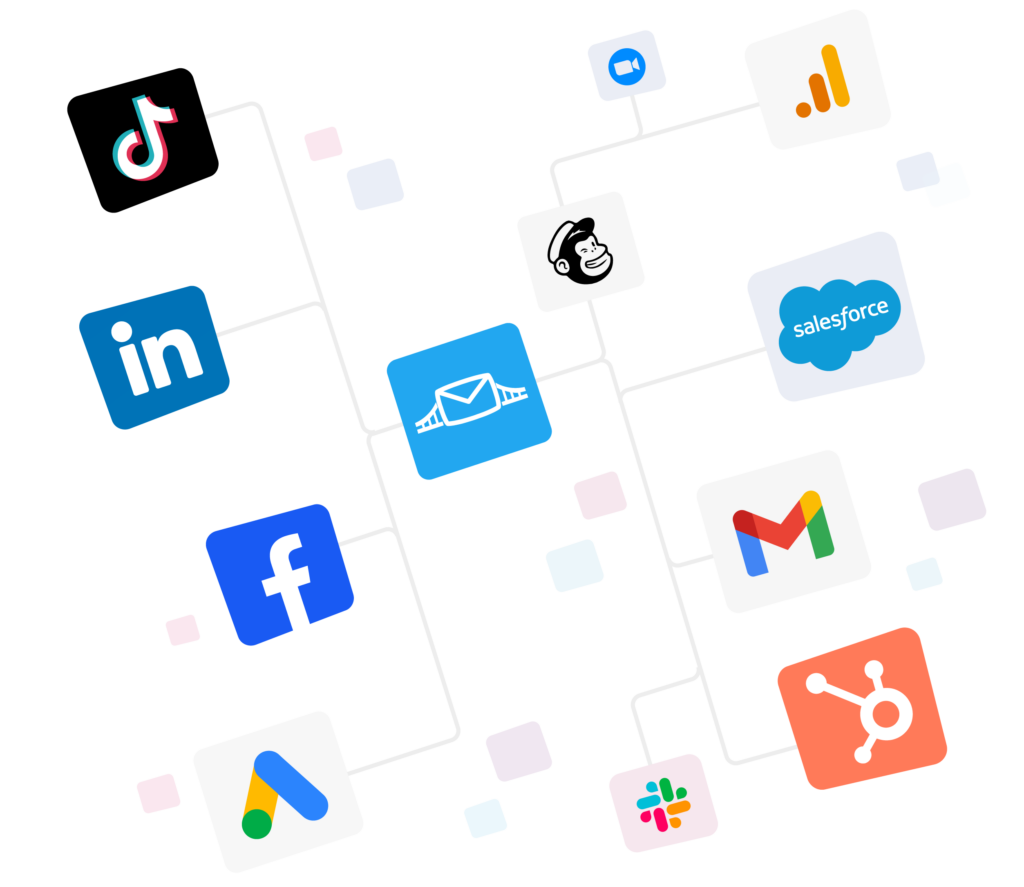
Automated data bridges connect your CRM to platforms like Meta, LinkedIn, Google, and TikTok, where you have your agency ad account. This way, your audience lists update automatically when a contact’s status changes.
That means you can suppress current clients, retarget high-intent prospects, and avoid wasting spend on the wrong people.


2. Match targeting to the platform
LinkedIn works well for precise B2B targeting by job title, seniority, company size, and industry.
Meta, however, is better suited for broader behavioral targeting, especially as its algorithms have become stronger at finding likely converters with fewer manual inputs.
Use LinkedIn for role-based campaigns like CMOs, Heads of Growth, or VP Marketing. And use Meta for creating broader awareness and retargeting for your agency.
LeadsBridge connects LinkedIn Lead Gen Forms and Matched Audiences to your CRM, so leads move straight into your workflows.


3. Follow up with lead form submissions instantly
Lead forms on LinkedIn and Facebook reduce friction, but they lose value if leads sit inside the platform for hours or days.
You need workflows that send new form submissions directly to your agency CRM in real time. A prospect who requests a consultation can be assigned, tagged, and added to a nurture sequence within seconds.


4. Send off-platform conversions back to ad platforms
Agency sales often close offline through calls, proposals, and follow-ups. If your ad platforms only see form fills, they optimize for leads.
You can do that by sending CRM conversion data back to LinkedIn, Meta, and TikTok. This helps the algorithms learn which campaigns drive your revenue.
And again, you need automation to do that for you:


5. Keep suppression lists clean
Showing prospecting ads to your current clients is not quite professional. So does retargeting a bad-fit or recently churned account.
Keeps your suppression lists updated automatically to avoid that. When a lead becomes a client, they leave prospecting audiences. When a client renews, they leave win-back campaigns.
6. Create content for specific segments
Generic content attracts generic leads. Specific content attracts better-fit prospects.
Instead of “10 ways to improve digital marketing,” write for a clear segment, like “How B2B SaaS companies with 50–200 employees should structure LinkedIn acquisition.”
The more specific the content, the easier it is to attract your target audience for a marketing agency.
7. Score and route leads before sales gets involved
Not every inbound lead deserves the same response. A marketing director at a 200-person SaaS company asking for a proposal is not the same as a freelancer asking for pricing.
Use CRM logic to score leads by company fit, behavior, and urgency. LeadsBridge helps transfer your lead data as soon as they arrive in your system and back to your ad platform’s audience tools.
Such as Facebook custom audiences, LinkedIn Matched Audiences, Google Customer Match, etc.
8. Review segment performance quarterly
Audience definitions age fast. Platform changes, market shifts, and competitor moves can all affect which segments convert best.
Review conversion rate, time-to-close, deal size, retention, and channel performance by segment every quarter. That keeps your targeting based on current data.
Digital marketing agency target audience: FAQs
1. What is the target audience for a digital marketing agency?
It’s the group of businesses and decision-makers most likely to hire your agency, stay long term, and get results. It’s defined by factors like industry, company size, revenue, growth stage, behavior, and marketing needs.
2. What is audience segmentation in digital marketing?
Audience segmentation means splitting a target audience for a marketing agency into smaller groups based on shared traits, needs, or behaviors.
For agencies, this helps work on messaging that’s perfected for the funnel stage, service need, company type, and buyer role.
3. What are the main target audience segments used by digital marketing agencies?
Looking at the best target audience examples, agencies usually segment by industry, company size, growth stage, service need, funnel stage, and decision-making role. The best segments come from closed-won CRM data, not assumptions.
Takeaways
Audience definition is not a one-time task. It’s an ongoing system that connects your positioning, CRM, campaigns, and follow-up to meet the expectations of your digital marketing agency’s target audience.
The agencies that win know exactly who they’re targeting and can act on that data in real time.
LeadsBridge helps by syncing CRM audiences, lead forms, offline conversions, and ad platforms across 380+ integrations, so your targeting stays accurate without manual work.
Explore LeadsBridge integrations to set up and start your audience activation.