

TL;DR
- Facebook can help real estate agents reach buyers, sellers, renters, and investors.
- Use Meta lead ads with strong visuals, simple forms, and clear offers.
- Follow Housing Special Ad Category rules to stay compliant.
- Add qualifying questions to get fewer but better leads.
- Sync leads with your CRM and follow up fast to improve conversions.
Facebook has become a game-changing platform for real estate professionals, offering unparalleled opportunities to connect with potential buyers and sellers.
So how do you get the most out of this platform? By having a high-performing Facebook advertising strategy.
- TL;DR
- Why use Facebook lead generation for real estate?
- How to use Facebook for real estate lead generation
- How to generate leads from Facebook for real estate
- Best Facebook ad examples for real estate lead generation
- Best practices for Facebook real estate lead generation
- Leverage LeadsBridge for the power of automation
- FAQs
- Final thoughts
This guide will walk you through everything you need to know about Facebook lead generation for real estate. It also offers best practices and tools that can help you generate high-quality leads and grow your business. Such as:


Why use Facebook lead generation for real estate?
Facebook is a cornerstone for modern real estate marketing. Here’s why Facebook is a must-use platform for lead generation in the real estate industry:
Massive audience reach
Meta’s apps reached an average of 3.64 billion daily active users as of October 2026. That’s Facebook, Instagram, Messenger, and WhatsApp combined. Some of those people are getting ready to buy, sell, or rent a home in your area. Facebook lets you reach them, plus a wider group that might move later.
Advanced targeting options
One of Facebook’s most powerful features is its ability to refine and segment your audience. You can narrow your reach by:
- Location
- Demographics
- Behaviors and interests
This precision targeting ensures your ads resonate with the right audience, maximizing engagement and return on investment (ROI).
Important note: Real estate ads often fall under Meta’s Housing Special Ad Category. If your ad is about buying, selling, or renting a home, you have to mark it as a Housing ad in Meta Ads Manager. This also covers agent services, mortgages, home insurance, appraisals, and home repairs. Mortgage ads usually need two labels: Housing and Financial products and services.
Once you pick Housing, you lose a lot of targeting. You can’t pick an age range or gender. You can’t target by ZIP code, and your location has to cover at least a 15-mile radius. You can’t use lookalike audiences or saved audiences, and you can’t exclude places or interests.
Don’t try to skip the label. Meta reviews the words and pictures in your ad. If it looks like a housing ad, Meta can reject it or apply the rules anyway. So put your effort into what you can control: your photos, your copy, your lead form, your CRM data, and how fast you follow up.
Lead ads for easy conversion
Facebook lead ads simplify the lead generation process. They come with pre-filled forms that minimize effort for the user, reduce friction and thereby increase conversions.
But don’t optimize only for the lowest cost per lead. For real estate, a slightly longer form with higher-intent settings and qualifying questions often produces fewer but better leads.
You can do this by:
- Using Higher intent forms for serious buyer/seller campaigns.
- Adding qualifying questions like timeline, property type, budget range, selling timeframe, or preferred area.
- Using conditional logic to route buyers, sellers, renters, and investors differently.
- Not asking for excessive information upfront; qualify enough to prioritize follow-up.
Automation opportunities
Managing leads manually can be time-consuming and inefficient, especially as your campaigns scale. With automation, you can:
- This efficiency allows you to focus more on closing deals and less on administrative tasks.
- Instantly sync leads to your CRM or email marketing software.
- Set up real-time notifications for immediate follow-ups.
- Track campaign performance and refine your strategy with ease.
Tools like LeadsBridge enable seamless integration between Facebook and your CRM to automate your entire lead data management.


How to use Facebook for real estate lead generation
Start by creating a dedicated Facebook Business Page that showcases your listings, testimonials, local expertise, and market insights.
Then build and run lead ads. With housing ads, Meta is your best bet for picking the target audience, as long as you feed it enough up-to-date data. Your ad copy helps too. An ad that asks “What’s your Maple Hills home worth?” will mostly get clicks from Maple Hills homeowners, even if Meta shows it across the whole metro area.
You still have a few audience tools:
- You can also turn on Advantage+ Audience and let Meta find people who are likely to respond. Just never build a list around age, family status, race, or any other protected trait.
- You can retarget people who visited your website or watched your videos.
- You can upload a list of past clients and contacts after you complete Meta’s customer list certification.
Lead generation Facebook ad ideas for real estate agents
New listing showcase ads
Promote a new listing with professional photos or a short video walkthrough. Use a lead form for scheduling private showings or requesting more information.
Here’s an ad where Averi Whitfield uses this strategy:

Free home valuation ads
Target homeowners with ads offering a free home valuation. Include a lead form where users submit their address and contact info to receive a personalized report.
See this strategy in action in an ad by Victoria Lee Holmes:

First-time buyer guides
Offer a downloadable guide or checklist for first-time homebuyers. This positions you as a helpful resource and captures emails through a gated lead form.
Here’s Tara Sawyer‘s take:

Coming soon & off-market listings
Build urgency and exclusivity by advertising “coming soon” or off-market properties. Encourage early access sign-ups through a lead form or Messenger bot.
Check out this listing teaser by Mike Muren:

Pair these lead ad ideas with a consistent email follow-up strategy to increase both the volume and quality of your real estate leads.
How to generate leads from Facebook for real estate
Facebook lead generation for real estate requires a strategic approach that puts all the platform’s unique tools and features to use.
These steps help you maximize your ads’ performance:
1. Create a Facebook lead ads campaign
Facebook lead ads are specifically designed to collect user information directly within the platform. To create an effective lead ads campaign:
- Access Meta Ads Manager: Navigate to Ads Manager to start setting up your campaign.
- Choose the “Leads” objective: This objective is tailored to capture leads. Then, you select instant forms, Messenger, calls, or a website as the conversion location depending on your workflow.
- Select your ad placements: Choose where your ads will appear, such as the Facebook Feed, Stories, or Marketplace. For real estate, visually driven placements like Stories and the Feed tend to perform best.
- Set your budget and schedule: Define a budget that aligns with your campaign goals and select the days and times your ads will run to maximize visibility during peak hours.
2. Define your target audience
Targeting the right audience is critical for success in Facebook real estate lead generation. Facebook’s advanced targeting tools let you focus on the most relevant prospects.

Let’s take a look at different types of targeting options:
- Location: Pick a city, address, or map pin. Housing ads need at least a 15-mile radius, and you can’t target or exclude ZIP codes.
- Custom audiences: Upload customer lists after you complete Meta’s certification. Website visitor and page engagement audiences also work.
- Advantage+ Audience: This works for housing ads. Meta looks for people likely to respond, within the housing rules.
- Retargeting: Show follow-up ads to people who visited your site or watched your videos. Don’t leave people out based on who they are.
- Separate ads, not separate audiences: Make different ads for buyers, sellers, renters, investors, luxury, and relocation. The message does the sorting that targeting used to do.
To do any of these, however, you need to connect your system to Meta automatically.
3. Create your lead ads
Crafting effective lead ads is essential to capturing attention and driving action. If you’re wondering how to generate real estate leads, here’s how to create compelling ads that stand out:
- Write a strong headline: Your headline should immediately grab attention and convey value. Examples include:
- “Find Your Dream Home Today!”
- “What’s Your Home Worth? Get a Free Valuation!”
- “Exclusive Listings in [Your City] – View Now!”
- Use high-quality visuals:
- Include professional photos or videos of properties you’re promoting.
- Showcase happy clients, local landmarks, or stunning interiors to evoke an emotional connection.
- Offer value: Give prospects a reason to engage. For instance:
- Free market reports.
- Exclusive access to property listings.
- A consultation with a real estate expert.
- Build a form that’s short:
- Name
- Phone number
- Add two or three questions that help you sort leads, like “When are you planning to move?” or “Are you already working with an agent?”
Setting up a high-performing strategy? Use automation to sync your Facebook leads with your CRM, enable real-time follow-ups, and improve lead management.


Best Facebook ad examples for real estate lead generation
Below are two powerful examples of successful Facebook ads for real estate lead generation, along with insights into what makes them effective.
1. Home value estimator ad: This type of ad is designed to attract homeowners who are curious about the current market value of their property.
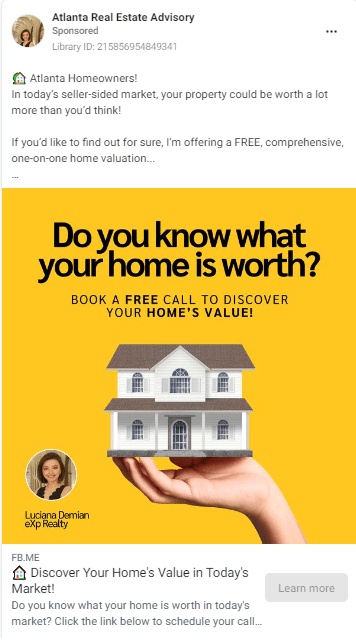
This ad taps into the emotional and financial interests of homeowners, offering immediate value and a reason to engage. Using a tool like LeadsBridge can help seamlessly integrate the captured leads into your CRM for timely follow-ups.

2. Price reduction ad: Prospective customers love nothing more than saving money and taking advantage of a real estate deal in real time.
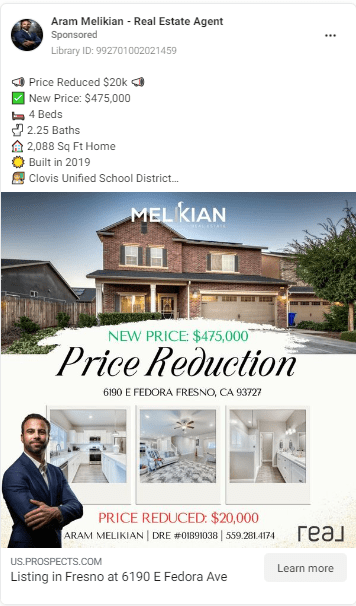
This format appeals to buyers’ natural inclination to save money, while also showcasing key home details and important contact information.
Best practices for Facebook real estate lead generation
To maximize the effectiveness of your real estate Facebook ads, it’s essential to go beyond just crafting a visually appealing ad.
Successful campaigns require a combination of strategic planning, emotional engagement, and adherence to platform guidelines.
Here are some best practices to consider:
- Declare the Housing Special Ad Category when required.
- Keep your ad copy fair and neutral. Avoid wording that points to age, family status, income level, financial hardship, or protected groups.
- Avoid phrases like “perfect for young families,” “ideal for retirees,” or “safe neighborhood,” as these can create fair-housing risks.
- Keep property details accurate and up to date, including price, availability, location, square footage, and listing status.
- Use strong photos, videos, virtual tours, and clear copy to attract the right audience without relying on restricted targeting.
- Use AI tools to test ad variations, improve headlines, resize creatives, and speed up campaign setup, but always review the output for accuracy and compliance.
- Add qualifying questions and higher-intent forms to reduce spam and better understand each lead’s needs.
- Follow up within minutes, not hours.
- Send qualified lead data back to Meta through your CRM or Conversions API when possible, so campaigns can optimize for better leads.


Learn all you need to know about Facebook ad rules here.
Leverage LeadsBridge for the power of automation
Managing leads manually can be overwhelming, especially when running multiple campaigns or dealing with high lead volumes. Manual processes often result in delays, missed opportunities, and data errors.
Integrating Facebook lead ads with your CRM through LeadsBridge can resolve all that and more.
Here’s how LeadsBridge can transform your workflow:
- Real-time lead sync:
LeadsBridge automatically transfers lead data from Facebook lead ads directly into your CRM, marketing automation tools, or email platforms. This ensures you can follow up with leads immediately, maximizing conversion opportunities.


- Send lead-quality data back to Meta:
Syncing leads into your CRM is step one. The stronger workflow is to send downstream events back to Meta, such as contacted, appointment booked, showing scheduled, listing consultation completed, qualified buyer, or closed deal. Custom audience integrations help campaigns optimize toward leads that actually convert.


Additionally, Conversion Leads integrations help send qualified lead data from your CRM back to Meta, so your campaigns can learn which leads are most likely to become customers.

- Multi-campaign tracking:
Monitor and manage leads from multiple campaigns effortlessly within a centralized dashboard. Conversions API integrations allow you to track performance, refine strategies, and allocate resources more effectively.
LeadsBridge’s tailored solutions are designed specifically for real estate professionals and can be set up in just a few clicks.
FAQs
Use Facebook lead ads to promote listings, home valuations, buyer guides, or consultation offers. For best results, use strong visuals, simple lead forms, fast follow-ups, and CRM automation to manage new real estate leads.
Yes, Facebook ads can work well for real estate when they are targeted correctly, follow housing ad rules, and offer clear value. Agents can use them to reach buyers, sellers, renters, and investors with listings, market updates, and lead forms.
To get Facebook leads for real estate, create a Meta Leads campaign, use an instant form, offer something valuable, and sync new leads to your CRM. Quick follow-up is key to turning Facebook leads into clients.
Yes, for most agents. Real estate does better than most industries with Facebook lead ads. Benchmarks show that real estate lead ads had a 4.17% click-through rate, the second highest of any industry.
About 1 in 10 clicks turned into a lead (9.95%), and the average lead cost $13.74.
Agents who get good results use Higher intent forms, ask two or three qualifying questions, and call new leads within minutes.
It depends on your market and your offer, but most benchmarks land between about $14 and $40 per lead.
Reports state that the real estate average is $13. That’s about half the $27 average across all industries. Superads, which tracks a larger set of ad accounts, found real estate leads cost about $29.50 on average from July 2025 to June 2026. Costs moved a lot by month, from $16.21 in November 2025 to $40.27 in January 2026.
Final thoughts
Effective lead generation is about building meaningful relationships with your prospects.
By investing in the right tools and strategies, you can capture leads and also turn them into loyal clients.
Ready to take your Facebook lead generation to the next level? Discover the power of Facebook lead ads integration with LeadsBridge today!