
Sales are the goal of every brand’s marketing, and that includes agencies. But getting a customer to buy once isn’t the finish line.
The real challenge is turning one-time buyers into loyal customers, and then into people who recommend you.
Today’s customer journey is disorganized. People switch devices, research for days, and bounce between social, search, email, and your website before they convert.
That makes it hard to plan each step separately.
The solution is a modern funnel built for cross-channel, multi-device behavior, supported by automated lead data management that keeps customer info connected and up to date, so you can nurture buyers and drive repeat sales.
In this article, we’ll cover all that you need to know to build a digital marketing agency funnel for better post-lead-generation strategies, in addition to automated integrations to help you streamline it.


Why should you have a marketing funnel for your digital agency?
Running an agency without a digital marketing agency funnel is a poor setup for generating and nurturing your leads.
You might get leads and even close some deals, but you can’t really explain what works and what needs improving. A robust marketing funnel fixes that by adding structure to your approach. It turns all your marketing efforts into a system you can measure, improve, and repeat.
Once you establish yourself as a trusted brand, most clients don’t just buy once and disappear. They:
- Need onboarding,
- Ask questions,
- Compare you to your competitors again later,
- Pause services,
- Come back when budgets reopen,
- Refer someone.
If your agency only focuses on getting the first yes, you miss out on all the future opportunities to cross-sell or upsell and get referred.
The modern funnel is built for an omnichannel or multi-channel marketing approach. Today’s buyer journey takes place across different platforms and stages.
That’s why a modern marketing funnel for digital agencies accepts that people bounce around. It also accounts for:
- Multiple channels hitting the same person (Meta, Google, LinkedIn, email, referrals),
- Expectations of personalization (“Talk to me like you know my industry”),
- Post-purchase experience (onboarding, performance updates, support),
- Retention strategies that keep clients longer and increase lifetime value.
The funnels’ job is to make your agency easier to grow (and less stressful to run). Instead of hoping leads show up, you know what activities create them and how long it takes.
A funnel also filters out bad-fit prospects early (budget too low, wrong niche, unrealistic expectations).
And when you map the steps, you can spot where people drop off, like when they book calls but don’t show, or they ghost after the proposal.
A high-performing funnel that includes onboarding and retention turns one project into a longer relationship. When you can see your funnel numbers, you’ll know if the issue is traffic, lead capture, follow-up speed, or closing.
Most agencies already have a funnel. But it’s often just invisible and leaky.
The best marketing funnel for a digital agency

If you sell services that require trust (which is basically all agency work), you need a multilayered digital marketing agency funnel that includes all these stages:
Stage 1: Awareness as the entry point
This is where your leads come in from. For example, you can use SEO, LinkedIn, paid ads, partner referrals, or lead gen campaigns, including improving your search engine positioning so the right prospects find you earlier in the journey.
It’s important that you send this traffic to a single focused page.
To put the reason for this in perspective, here’s an interesting stat: Emails with one clear call to action earn 371% more clicks than emails that ask readers to do multiple things.
Stage 2: Consideration, where you provide proof and clarity
Your aim is to help your leads move down the funnel. So give them what they actually need to decide.
These can be case studies, specific outcomes of your services, who you’re best for (and who you’re not for), and a process overview (a simple version of it).
Your job here is to reduce uncertainty, so don’t push for selling to someone who still questions what you do in the first place.
Stage 3: Conversion and booking funnel
The best conversion offer for most agencies is book-a-call CTAs.
No matter where you market, include a link to a landing page along with a short qualification form, such as lead ads for data collection and contact permissions.
Bonus points if you can add a calendar booking button on the landing page. Of course, this should always be included on your landing page.
Use professional services like HubSpot to create solid landing pages:

Most agencies have a Contact us button on their contact page, but their service page goes for the call booking directly. The Contact us form can create friction and delays at this stage.
Stage 4: Retention as part of your onboarding funnel
The first 1–2 weeks of onboarding are when you can decide whether a client stays.
You need kickoff steps and timelines, an asset checklist (access, accounts, creatives, tracking), clear reporting rhythm, and early quick wins if possible. Consider an executive communication course to improve kickoff calls, align stakeholders, and deliver concise updates – reducing onboarding friction and boosting client confidence in the first two weeks.

Make your onboarding sloppy, and you are going to have churn immediately.
Stage 5: Advocacy and referral system
Don’t just hope for referrals. Ask any clients who have been seeing some success. This can be a campaign launch success, a lead spike, etc.

Also, make it easy for them to refer you. For example, send a short referral message that they can forward.
How the common funnel types fit together (they’re not competing)
Of course, there are different types of funnels, which you need to use separately but in harmony. These are building blocks that support the core 5-stage marketing funnel for a digital agency.

You can use:
- Lead generation funnel to capture contact details. Best agency lead magnets: audit, checklist, short playbook, workshop, benchmark report.
- Content funnel to build trust before the call. Content that moves deals forward includes how-tos, mistakes we made, case study breakdowns, etc.
- Email funnel for consistent follow-up.
- Webinar signup funnel to educate and qualify at scale.
- Sales call booking funnel to turn interest into a real sales conversation. Keep this one for your high-ticket services.
- Onboarding funnel to reduce churn and increase lifetime value.
How to streamline the digital marketing agency funnel
Most digital marketing agency funnels don’t fail because the strategy is bad. They fail because execution is slow and messy: leads land in five places, follow-up is late, and nobody on the team can trust the reporting because items can be out of date.
Automation fixes those weak points. Here’s how to implement that.
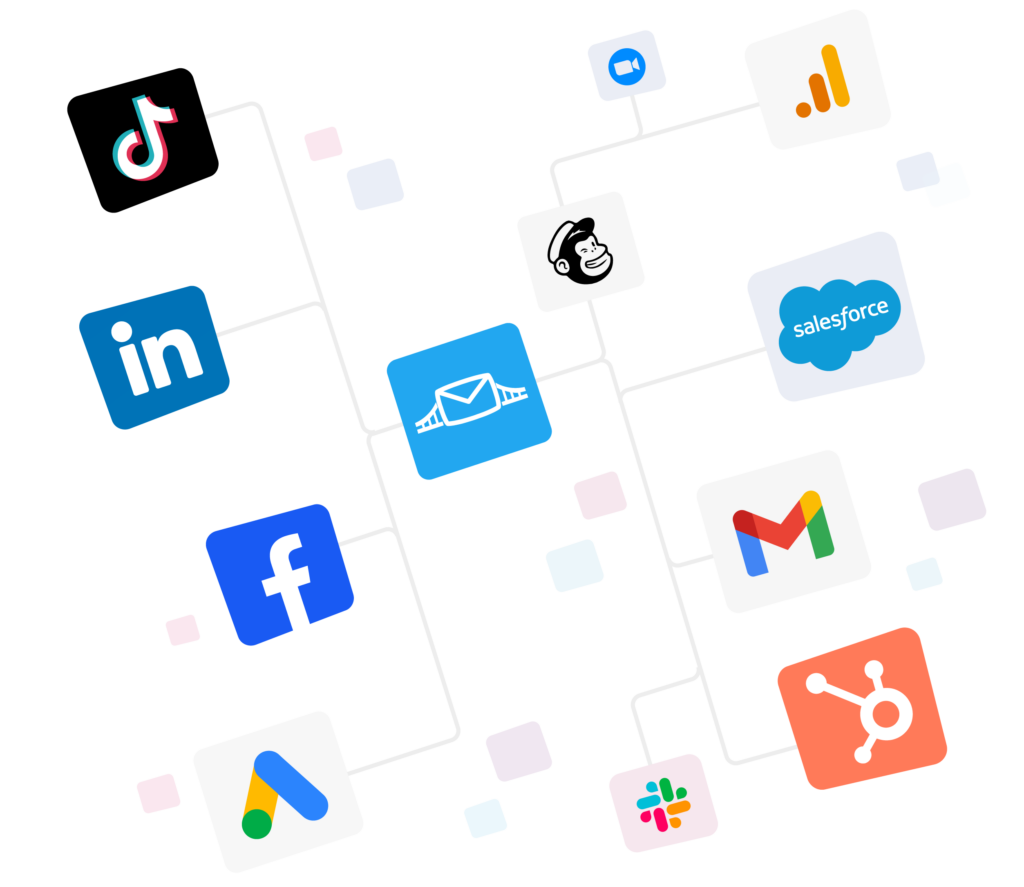
1. Centralize incoming data from every lead source.
If you run lead gen ads, you’re usually pulling leads from native ad forms. The ones to plan for are:
- Meta lead ads (used on Facebook and Instagram through Meta Ads Manager)
- LinkedIn Lead Gen Forms
- Google Ads lead form assets (formerly “lead form extensions”)
- TikTok Instant Form for lead generation
Without automation, these leads end up as CSV files, or delayed email alerts. That delay costs you deals.
Instead, you need to get every lead into your CRM (or whatever system you run your pipeline in) in real time, with the same fields every time.


Additionally, make sure to standardize fields across sources. You need to pick a core set (name, email, phone, company, service interest, budget range, timeline) and align everything to it.
2. Automate routing
Syncing a lead into a CRM is step one. Your step two is making sure the right person owns it immediately.
Good, effective routing rules include routing by service line (PPC vs SEO vs full-funnel), region and time zone, deal size, or round-robin (to your team members) by their skills and capacity.
The goal is that everyone knows which leads are theirs based on their assigned funnel and current responsibilities without delays or confusion.
Then add an automation for the first hour through email or autoresponder integrations for:
- Instant confirmation (here’s the next step, sort of communication). Here are the most popular integrations:


- Internal alert to the owner. LeadsBridge lets you do this for free via the email receipt feature available on data bridges or via SMS and email integrations.


- Task created in the CRM
- Calendar link sent if your funnel is call-based
That’s how you narrow your speed-to-lead window without a hands-on approach.
3. Improve audience accuracy with always-updated custom audiences
Agencies waste ad spend when audiences are outdated. The fix is keeping audiences tied to real funnel stages and syncing them automatically.
Here are the main custom audience features you’ll use to increase your audience-building accuracy, based on the platform you are using to generate leads:
- Meta custom audiences (including customer list audiences)


When you keep these platforms in sync with your CRM, your targeting gets cleaner because it’s based on reliable data.
You can also exclude current customers (so you stop paying to advertise to people who already bought), retarget those who booked a call but didn’t show, and build lookalikes from closed-won clients instead of all leads.
Learn more about Facebook retargeting ads here.
4. Close the loop with conversion data
For most agencies, the real value happens later than the lead generation stage. This usually takes place during qualified calls, proposals accepted, closed-won deals, and renewals.
So you want your ad platforms to optimize toward those outcomes. That means sending conversion events from your CRM and pipeline back into the ad platforms:


Conversion tracking usually improves your optimization and makes reporting more genuine, because you’re essentially tying your ad spend to pipeline outcomes.
5. Keep your nurturing campaigns simple, but consistent
Automation is how you stop good leads from going cold. And when emails bounce or go unanswered, you can use tools like an email finder to discover an alternate email address and keep the conversation moving.
A simple nurture setup is enough for most agencies. For instance, a short sequence over 1–2 weeks that answers common objections (pricing, timeline, proof, process) and keeps the call-to-action consistent (book a call or request an audit).
The point is a steady follow-up without manual intervention. And for that, you need pre-built nurturing sequences that you can put on autopilot using automated bridges that connect your leads to your marketing platform.

Final thoughts
So what is the best marketing funnel for a digital agency?
A digital marketing agency funnel that scales starts with clarity. It allows you to know your target audience, their pain points, and what convinces them to choose an agency.
Build content that answers those needs, drives one clear next step, then track the numbers and keep adjusting based on what actually converts.
When your funnel metrics connect to ad spend and CRM outcomes, you get real ROI visibility, so you can invest more in what’s working and cut what isn’t.
Automation keeps it manageable for you since you can sync your leads, audiences, and conversions in near real time.
Discover LeadsBridge’s niche-specific agency integrations to streamline your funnel.