
B2B lead gen can be resource-heavy. That’s why having a solid funnel matters even more.
A good B2B lead generation funnel gives your team a shared map. It shows where leads come from, what they need next, and which numbers tell you if things are working.
In this guide, you’ll get a five-stage structure that lines up with the stage-based approach lead generation for B2B teams that care about handoff, tracking, and lead quality.
TL;DR
- A B2B lead generation funnel is the path people take from the first click to a qualified lead.
- It’s different from B2C because the process is usually slower, more research-heavy, and more dependent on trust.
- The main stages are discovery, interest, appraisal, confirmation, and conversion.
- Each stage needs its own tactics. And its own metrics.
- If you only track lead volume, you’ll miss what’s actually broken.
- LeadsBridge can help by connecting lead sources and syncing lead data into your CRM or marketing tools in real time.


What is a B2B lead generation funnel?
A B2B lead generation funnel is a series of steps that moves someone from the first encounter with your brand to booking a demo or asking to talk to sales.
Buyers don’t just click once and buy. Once a person discovers your brand, they are at the top of the funnel.
They then move down the funnel by checking your landing page or social media page. When they start comparing you with your competitors and look for proof, they are at the lower end of your funnel.
In a classic funnel, a conversion usually sits at the bottom.
Why B2B funnels are different than B2C?
B2B buyers want proof, product specifics and clear use cases before they buy. They may read a case study or request a demo. That means a B2B client needs way more than one touchpoint.
That’s why B2B funnels tend to be more content-heavy and contain more trust signals compared to B2C funnels.
There’s in fact a whole stage around appraisal, where buyers research you on third-party sites and compare you with competitors. This is mostly absent in B2C funnels
Same as the confirmation stage, where case studies and trust elements help close the gap. That’s very B2B.
Another major difference between the two is how data is managed. In B2B, a lead should never be kept waiting.
To make this all work, you need an automated funnel to have your leads routed, segmented, and synced into the right tools fast. That’s why most B2B teams use solutions like LeadsBridge to streamline the path the lead data takes into your systems.
B2B Facebook ads work wonders for this stage.
The key stages of a B2B lead generation funnel
Below is the working model.
| Funnel stage | Goal | Common tactics | Key metrics |
| Discovery | Get in front of the right people | SEO, paid search, LinkedIn ads, paid social, webinars, events | Impressions, CTR, CPC, new visitors |
| Interest | Turn traffic into engaged prospects | Landing pages, blog posts, guides, lead magnets, webinars | Bounce rate, time on page, form view rate, lead magnet downloads |
| Appraisal | Help buyers compare and validate | Retargeting, review management, comparison pages, nurture emails | Returning visitors, branded search, review signals, engaged sessions |
| Confirmation | Remove doubt and push intent higher | Case studies, demos, product pages, social proof, sales enablement content | Demo requests, MQL rate, sales accepted lead rate |
| Conversion | Capture the lead cleanly and fast | Short forms, booking pages, CRM sync, routing, follow-up workflows | CVR, CPL, cost per MQL, speed to lead |
Stage 1: Discovery
This is the top of your funnel. Your job here is to reach more qualified leads. Channels like SEO, PPC, trade shows, LinkedIn Ads, and public speaking are common ways B2B brands drive discovery. Where you put your focus really depends on where your audience is mostly engaged.
For most teams, a high-performing lead generation strategy involves organic search combined with paid search, LinkedIn, paid social, webinars, and partnerships.
What works here:
- Search-led content for pain-point keywords
- LinkedIn campaigns aimed at the right roles
- Paid lead gen campaigns with a clear offer
- Strong webinar or guide topics
- Retargeting pools built early
Watch for:
- Impressions
- Click-through rate
- Cost per click
- New users
- Traffic by channel
- Percent of qualified traffic
You don’t want to chase volume. A thousand clicks from the wrong crowd is still the wrong crowd, which would just mean wasted ad budget.
Learn more about how to reduce your ad costs here.
Stage 2: Interest
In this stage, leads on your site are looking around. They may also be a bit skeptical at this stage.
The interest stage is about relevance and friction. Buyers need straightforward information and low-friction content at this point. Blogs, landing pages, webinars, slideshows, and original research are useful content types here.
What works here:
- Landing pages with one offer, one CTA
- Short forms
- Useful blog content
- Downloadable assets
- Webinar registration pages
- Mobile-friendly experiences
Watch for:
- Bounce rate
- Time on page
- Scroll depth
- Form view rate
- Form completion rate
- Cost per lead
Leads that are looking around your site are usually considered good traffic. But if your page is vague or too long, or the form asks for way too much, you might lose them for good.
Stage 3: Appraisal
Appraisal is the stage where buyers do independent research off of your platforms and judge your reputation on places like Google, LinkedIn, and Glassdoor (as well as G2, Capterra, TrustRadius, or Gartner Peer Insights).
Your leads have just started checking you out. They may be reading reviews, looking at your LinkedIn page, or comparing you with someone else.
So yes, this part of the funnel is partly outside your control.
What works here:
- Comparison pages
- Customer stories (here are some examples)
- Strong review presence
- Retargeting ads
- Nurture emails that answer objections
- Clear category positioning
Watch for:
- Returning visitor rate
- Branded search lift
- Engaged sessions from retargeting
- Email click rate
- Review volume and review quality
Think of this stage as trust-building without being too salesy.
Stage 4: Confirmation
Your leads are close now.
This is where buyers want proof. Case studies and trust-focused content here, with an emphasis on transparency and honest expectations.
What works here:
- Demo pages
- Case studies
- ROI explainers
- Pricing guidance
- Testimonials
- Sales enablement assets
Watch for:
- Demo request rate
- Marketing qualified lead rate
- Sales accepted lead rate
- CTA click rate
- Bottom-funnel page conversion rate
If a lead stalls here, the issue is usually one of three things:
- Weak proof
- Weak offer
- Poor follow-up.
Stage 5: Conversion
While there are sales funnels where sales are the conversion, there are also other types of hand-raise.
- Form fill
- Demo booked
- Meeting requested
- Contact sales click
- Whatever else that counts as the lead event for your team.
You need to make your conversion quick and straightforward, with easy-to-find contact paths and simple forms.
LeadsBridge makes a similar point in its form best-practices content: keep forms short, make the benefit clear, and make the experience mobile-friendly.
What works here:
- Simple forms
- Fast loading pages
- Clear booking paths
- Auto-routing
- CRM sync
- Instant follow-up
Watch for:
- Conversion rate
- Cost per lead
- Cost per MQL
- Speed to lead
- Lead-to-opportunity rate
- No-show rate for booked demos
Essential B2B Sales Funnel Metrics and KPIs
Here are the ones that matter:
- Traffic quality metrics for the top of funnel, including CTR, CPC, new users, and traffic by source. They tell you whether the right people are getting in.
- Engagement metrics in the middle of your funnel. These can be bounce rate, time on page, scroll depth, form view rate, and download rate, which show whether the message lands.
- Conversion metrics for the bottom of the funnel. Anything from completion rate to demo request rate, conversion rate, cost per lead, and cost per MQL. These show whether the funnel actually produces your pipeline.
- Handoff metrics: You also want to track speed to lead, MQL-to-SAL rate, and lead-to-opportunity rate, which help in improving your nurturing and optimization.

How to optimize a B2B lead generation funnel
The first thing you want to do is work on your ICP and map the buying journey.
Because if you do not know who you want, it’s hard to strategize your funnel steps.
This is where your B2B marketing automation needs to have a solid base.
For example, when you need to sync CRM segments, email lists, or customer lists to B2B ad platforms, you can build audiences from actual data. And keep them updated automatically.
You need to do this optimization by stage so your funnel is part of an interconnected data system.
- At Discovery, the goal is to get in front of the right people.
This stage is about improving your targeting, building better audience segments, and matching your message to real buyer pain points. Usually that’s done by industry, job title, company size, funnel stage, or past engagement.
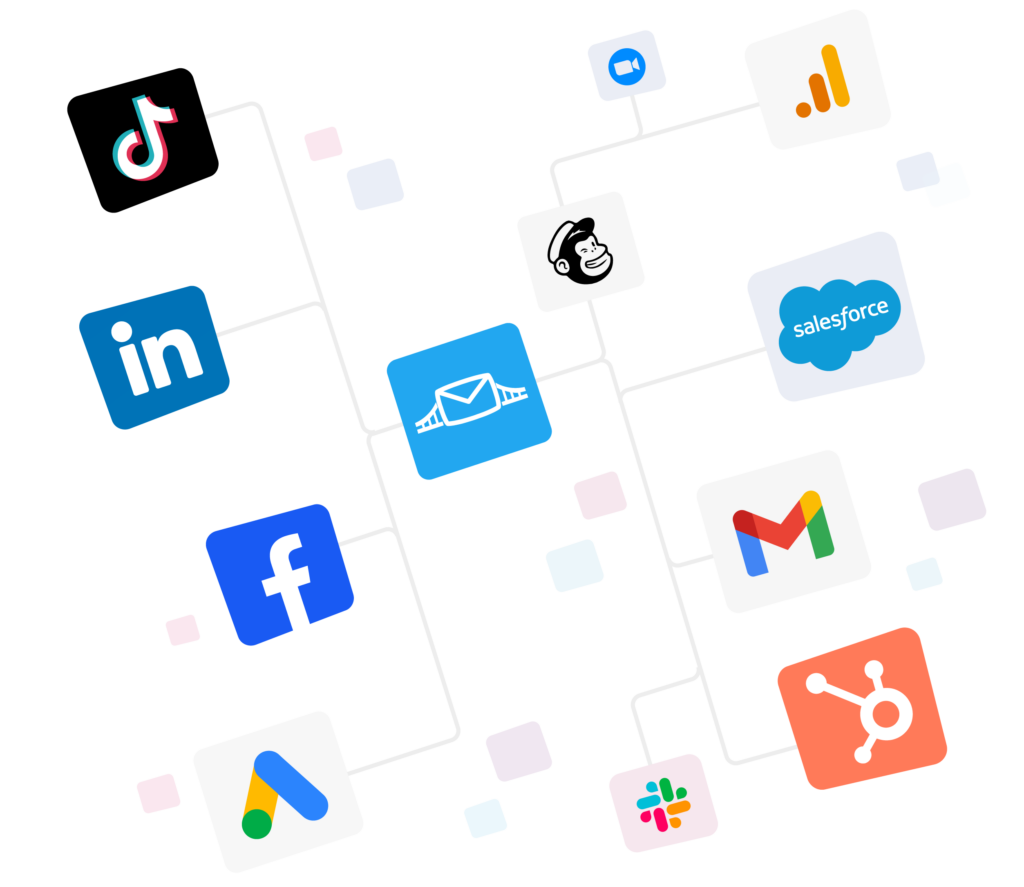
LeadsBridge audience integrations let you sync CRM lists and customer data into platforms like LinkedIn Matched Audiences, Facebook custom audiences, and Google Customer Match. So your top-of-funnel campaigns reach people who actually look like pipeline.


- At Interest, the goal is to turn attention into action.
Now your work is about reducing friction with leaner landing pages, shorter forms, better offers, and faster lead capture and nurturing.
Once someone fills out a form, that data needs to move right away. LeadsBridge can send leads from:
- Facebook lead ads
- Instagram lead ads
- LinkedIn Lead Gen Forms
- Google Ads lead forms
- YouTube lead forms
- Snapchat lead generation
- TikTok lead generation
And any other platform you are generating leads on straight into your CRM or marketing platform in real time.
Usually, these integrations give you the chance to set up faster follow-up, which also means fewer leads going cold.


Webinars are also a great solution to boost the Interest stage. Someone is not ready to buy yet. Tools like Zoom Webinar, WebinarJam, GoToWebinar, Easy Webinar, and Cisco Webex can connect with your CRM and email platform.
Integrations send contacts from your lead gen campaigns and CRM straight into your webinar registration flow.


- At Appraisal, the goal is to stay in the picture while buyers compare options.
This is the stage where people circle back. They visit your site again, click an ad, and read a case study. Then they disappear for a bit. You need great tracking so that none of these signals go unnoticed.
With integrations like LinkedIn Conversions API, Facebook Conversions API, you can feed later-stage conversion data back into your ad platforms. This is essentially B2B data enrichment, which keeps your retargeting accurate and your spend focused.


- At Confirmation, the goal is to give each lead the right proof at the right time.
This stage is really about segmentation and routing. LeadsBridge helps by syncing incoming leads into the right system fast, so they can be tagged, segmented, and moved into the right follow-up flow.
Email marketing and marketing automation integrations help move contacts into nurture flows, product education sequences, or sales-touch campaigns automatically, based on what they did earlier in the funnel.


- At Conversion, the goal is speed.
At Conversion, speed matters. And so does follow-through.
Besides your lead ads integrations, SMS reminder integrations like Twilio or SMS Notification can help teams send instant follow-ups, demo reminders, and agent alerts the moment a lead comes in, so fewer prospects go cold before sales get there.


Calendar and appointment integrations also help at the conversion stage by connecting booked meetings with the rest of your lead flow, so demo requests turn into confirmed next steps.
If phone calls are part of your funnel, call tracking integrations can help connect those conversations back to your CRM and campaign data. This data gives teams a clearer view of which channels actually drive sales-ready leads.


| Funnel stage | Goal | What to do | Integrations |
| Foundation | Build a smarter funnel strategy | Define your ICP, map the buying journey, and use automation to keep audience data connected across platforms | CRM sync, email list sync, customer list sync, audience integrations |
| Discovery | Reach the right people | Improve targeting, build better audience segments, and align messaging to real buyer pain points by industry, role, company size, funnel stage, or engagement history | LinkedIn Matched Audiences, Facebook custom audiences, Google Customer Match |
| Interest | Turn attention into action | Reduce friction with cleaner landing pages, shorter forms, better offers, and faster lead capture | Meta lead ads, LinkedIn Lead Gen Forms, Google Ads Lead Forms, YouTube Lead Forms |
| Interest | Nurture early engagement | Move webinar registrants straight into nurture flows, follow-up sequences, and lead management without manual work | Zoom Webinar, WebinarJam, GoToWebinar, Easy Webinar, Cisco Webex |
| Appraisal | Stay visible while buyers compare | Track return visits, ad clicks, and buyer signals so retargeting stays accurate and budget stays focused | LinkedIn Conversions API, Facebook Conversions API |
| Confirmation | Deliver the right proof at the right time | Segment and route leads into the right follow-up flow, nurture track, or sales sequence based on behavior and stage | Lead Sync, email marketing integrations, marketing automation integrations |
| Conversion | Respond fast | Send instant follow-ups, demo reminders, and alerts so hot leads do not cool off before sales gets there | Twilio, SMS Notification |
| Conversion | Lock in the next step | Connect booked meetings with the rest of your lead flow so demo requests become confirmed next actions | Calendar and appointment integrations |
| Conversion | Track sales-ready actions | Connect phone calls back to CRM and campaign data to see which channels really drive sales conversations | Call tracking integrations |
FAQs
1. What is a B2B lead generation funnel?
It’s the process that moves a business buyer from first discovery to becoming a qualified lead. Usually through stages like discovery, interest, appraisal, confirmation, and conversion.
2. What is the best way to generate B2B leads?
No single channel wins every time. The better answer is a mix strategy that has strong targeting, a useful offer, a clear landing page, and a solid conversion path into your CRM.
Additionally, organic search, LinkedIn, paid lead forms, webinars, and nurture workflows can all play a role.
3. How long is a typical B2B sales funnel?
It depends on your offer, price point, and market. But B2B funnels are usually slower than consumer funnels because buyers spend more time researching, comparing, and validating before they convert.
Final takeaway
A B2B lead generation marketing funnel is an operating system.
When each stage has a goal, a tactic, and a metric, things get clearer fast. Marketing knows what to improve. While your sales get better leads and your ops have access to cleaner data. Everybody wins.
This is all possible if only your lead sources, forms, ad platforms, and CRM are all connected to each other in real time.