
Running automotive Facebook lead generation ads doesn’t mean getting ready-to-buy people on demand.
Far from it.
Facebook can generate a ton of leads fast, but turning them into actual car buyers depends on many factors. That could be your offer, your form setup, and (most of all) your follow-up speed.
This article focuses on what the main automotive Facebook lead generation ads options can do, when to use each one, how to set them up, and how to stop paying for low-quality leads that almost never convert.
- What is automotive lead generation (and why ads on Facebook matter a lot!)
- The main automotive lead gen options on Facebook
- Meta lead ads: Pick the right form type
- How to create Facebook lead ads for automotive
- How to create high-converting automotive Facebook lead ads
- Automotive Facebook lead generation ads: Cost expectations
- How automation helps you improve your automotive Facebook lead generation ads
- Final thoughts
In addition, we’ll discuss strategies and tools such as automation solutions that can change the outcome of the same campaigns by changing your approach to data management, including:


What is automotive lead generation (and why ads on Facebook matter a lot!)
Automotive lead generation on social media is about getting a user to raise their virtual hand as an ‘interested’ signal. This is usually done by sharing contact info, so you can move them toward an appointment setup, a test drive, and a sale offer.
Automotive Facebook lead ads are still the go-to for many automotive advertisers because they’re built for:
- Discovery: People scroll even when they’re not actively searching.
- Retargeting: You can re-hit site visitors and engaged users.
- Low-friction forms: Lead ads and Instant Forms reduce the number of steps.
Unfortunately, low-friction forms can attract many low-intent users as well. So your job is to add the right friction by including qualifying questions and the right follow-up.
The main automotive lead gen options on Facebook
You should know which automotive lead gen options on Facebook work for the campaign you are designing. Unlike what most new advertisers think, not every campaign should be a lead ad.
| Option | What it is | Best for | Tradeoff |
| Lead ads (Instant Forms) | In-app form, prefilled fields | High volume, promos, service specials, quick offers | More junk leads if the form is too easy |
| Website conversion ads | Click to your landing page (credit app, trade-in, VDP, etc.) | Higher intent, better filtering, better tracking | Lower volume, needs a strong page |
| Messages (Messenger, WhatsApp, and IG DM) | Start a chat | “Is it available?”, credit questions, appointment setting | Needs fast replies + staffing |
| Calls | Tap-to-call | Hot shoppers, used cars, BDC-driven stores | More expensive, harder after-hours |
| Retargeting | Ads to warm audiences | Turning “maybe later” into “book it” | Needs audience + good creative rotation |
Keep in mind that your lead generation is as good as your follow-up system. A lead that waits 2 hours often turns into a cold lead.
Meta lead ads: Pick the right form type
Meta’s instant forms include different form styles.
In practice, this is one of the biggest quality controls you can use. Higher Intent tends to lower the number of accidental submissions because users have to confirm details.
And when it comes to car sales leads, many dealerships do better with fewer leads that answer vs. more leads that ghost.
Instant form types include:
- More volume (default): Optimized for quick mobile submissions and a higher number of leads.
- Higher intent: Designed to attract more serious prospects (e.g., booking a test drive).
- Rich creative: A more flexible, personalized form experience tailored to your audience.
Meta lead ads use cases
The best-performing automotive Facebook lead gen ads usually align with the shopper journey.
Take a look at this below:
| Shopper intent | Offer angle | Lead form headline example | Best next step |
| Price or payment | Payment estimate, rebates, and lease offers | “Get your monthly payment options.” | Call and text in 5 minutes, and 2 payment paths |
| Trade-in | “Real trade-in range” | “Get your trade value (fast).” | Book appraisal + ask about payoff |
| Credit or financing | Pre-qualify or soft pull messaging (if applicable) | “See financing options today” | Route to the finance team and status tracking |
| Specific vehicle | VIN-based offer | “Is this still available? Get details” | Confirm stock and appointment CTA |
| Service | Coupon or offer | “Claim your service offer.” | Online booking and reminders |
Here’s an example by Vancouver Car Centre that focuses on soft pull messaging that is angled toward pricing (the third option in the table above).

How to create Facebook lead ads for automotive
This setup is rather basic. But get it right, and you can build a strong foundation for optimization, retargeting, and campaign reruns in the near future.
Now, let’s go through how to create Facebook lead ads for automotive:
- Go to Ads Manager and click Create Campaign.
- When choosing Campaign objective: Choose Leads.

- For your conversion location, select instant forms (which are basically your lead ads).

- When choosing your audience, start with one core audience (this includes geo and basic demo) and one retargeting audience.

- Your creative should use real inventory photos or simple offer graphics. Also, always keep the text short and on point.
- Now it’s time to select your form type. Choose Higher Intent for sales offers (most of the time).

- Also, add your basic questions as well as qualifying questions. Ask for name, phone number, email, and up to 1–2 qualifying questions.
- For the thank-you screen, add:
- “Text us now” or “Call now.”
- Link to inventory or scheduler
- This one is on you. Make sure leads go directly into your automotive CRM in real time. The best way to do this is via a Meta-recommended partner like LeadsBridge.
Fun fact: LeadsBridge was the first to create integrations and partner with Meta for Meta lead ads data transfers.


How to create high-converting automotive Facebook lead ads
These are the features and qualities all the top automotive marketers on Meta agree on:
1. Having strategic qualifying questions in the instant form
Your goal is to filter out the worst leads without filtering volume.
Good qualifying questions:
- “Are you looking for new or used?”
- “When are you looking to buy?” (0–7 days, 8–30, 31+)
- “Do you have a trade-in?” (yes or no)
Make sure to avoid:
- Asking for income details
- Too many open-text questions
- Anything that feels like homework
It’s proven that one extra qualifier can cut junk leads.
But the biggest quality jump usually comes from a clear offer and your follow-up speed, which can be optimized with automated data management for automotive businesses.


2. Make the offer specific
Let’s take a look at three hypothetical ads with different CTAs.
Bad: “Get more info!”
Better: “Get 3 payment options on the 2024 [Model].”
Best: “See payments with $0 down vs $2,500 down (takes 30 seconds).”
Specific offers also help the user understand your angle while making your sales team’s first message easier.
3. Use creative that answers the first 2 questions shoppers always have
Those questions are:
- “Is this deal real?”
- “Can I get this in my area?”
So, to turn their confusion into a decision, include:
- Model and trim (or at least model)
- A real offer hook (payment, APR range, rebate, trade help)
- Store name (yes, really)
- Geo cues (“Serving Tampa Bay” style)
4. Treat follow-up speed as a must
If you contact late, your odds of getting a conversion decrease a lot.
Here’s a simple dealership lead SLA that works:
| Time after lead | Action | Channel |
| 0–5 minutes | First reach-out | Text and call |
| 10–15 minutes | Second attempt | Call |
| Same day | Value message | Text or email with inventory link |
| 24–72 hours | Nurture touches | 3–5 touches total |
| 7–14 days | Retarget and a soft check-in | Ads and text |
Stores that batch their lead follow-ups, for example, by checking them twice a day, usually lose leads to stores that respond right away.
Automotive Facebook lead generation ads: Cost expectations
Costs vary by market, inventory, targeting, and season.
But you can still plan with ranges.
A July 2025 report on Lead Form ads averaged a lower CPL than other Facebook ad formats overall.
Auto industry lead costs can also swing widely depending on channel mix and how “all-in” costs are calculated.
| Metric | Typical planning range | What moves it the most |
| Cost per lead (lead ads) | About $20–$60 (common), higher in tough markets | Offer strength, follow-up, and audience |
| Cost per lead (higher intent website) | About $40–$120 | Landing page, tracking, and intent |
| CPC (automotive) | Often a few dollars | Competition and creative relevance |
While ad costs are important, make sure your focus isn’t on the cheapest CPL. The win is the cost per appointment shown and the cost per sale.
By improving the quality of your ad and your targeting, Meta will automatically reduce your ad costs down the line.
How automation helps you improve your automotive Facebook lead generation ads
Lead ads work best when your automotive marketing strategy is secure from the moment a lead comes into your system, the follow-up, and how you nurture the same lead.
In the current advertising ecosystem, this chain must be automatic.
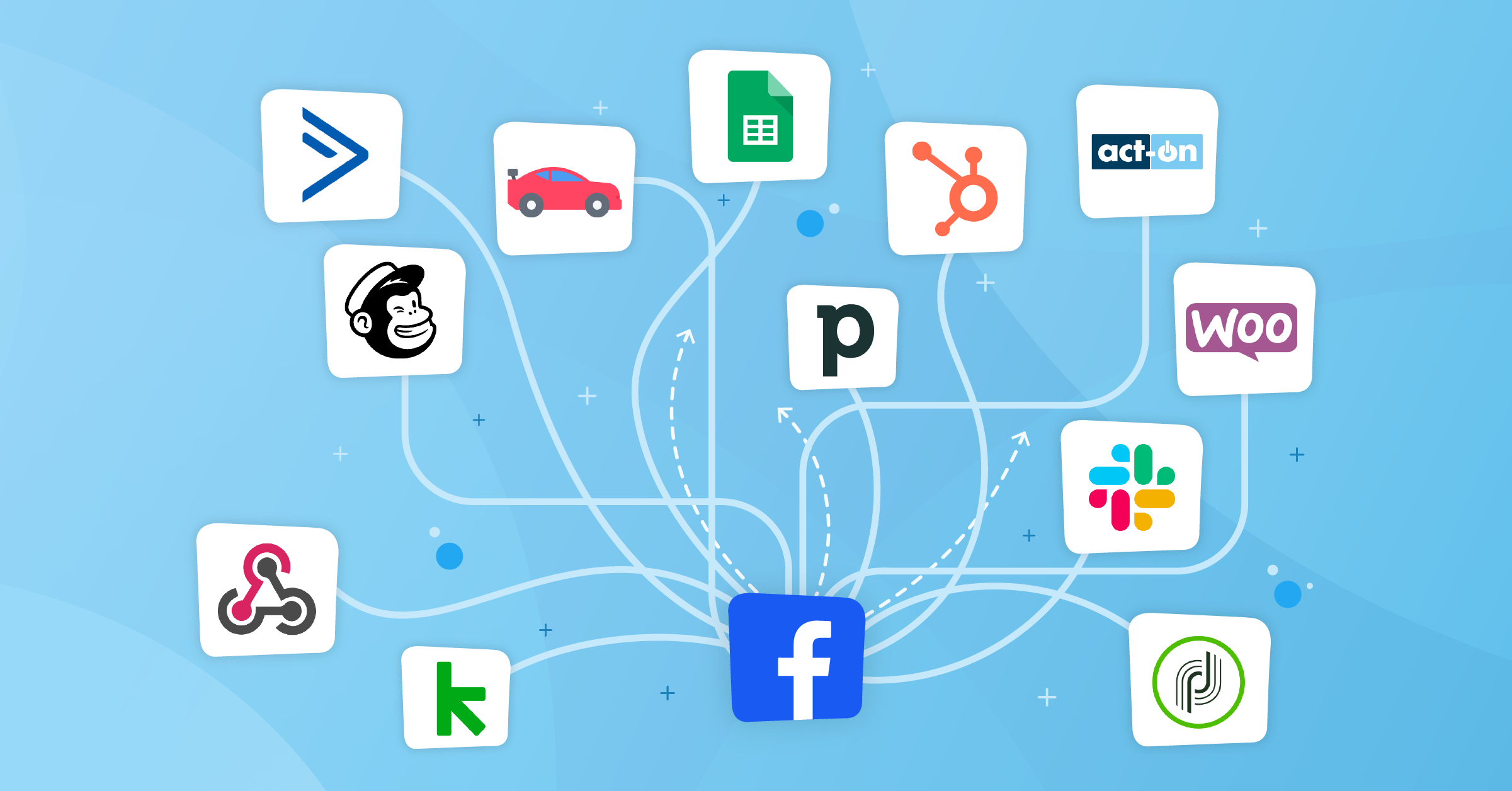
When LeadsBridge connects your Meta leads to your automotive CRM, you can:
- Sync leads in real time, which means no CSV exports and imports
- Route leads to the right team, such as sales vs. service, new vs. used

- Trigger instant SMS, autoresponders, and email follow-ups


- Build audience segments to retarget them later based on lead traits

- Track real outcomes with conversion data
- Improve your targeting via Conversion Leads optimization goal integrations

Looking for the top automotive CRM solutions?
Here’s how to use VinSolutions and get the most out of it.
Optimization as your next logical step: Conversions API setup
Meta’s Conversions API is meant to connect first-party events (web, app, CRM events, etc) back to Meta for measurement and optimization.
Meta also has guidance for uploading lead events from CRM systems for lead ads use cases.
In addition to your Meta Pixel data, Conversions API rounds out your entire data tracking system. If Meta can view which leads became appointments or sales (in a privacy-safe way), it can optimize toward the users who are actually looking for your services.
Also, you can analyze this data to see what campaigns are bringing more qualified leads, so you can make more of them in the future.
All you have to do is connect your CRM to Meta via Conversions API.

Another bonus point is that LeadsBridge registered users can access exclusive services like LeadsBridge Performance Booster.
This feature connects your CRM to Meta via the Conversions API and sends back what happens after the form submit (booked calls, purchases, deals won or lost).
That closed loop, which includes first-party feedback, helps Meta optimize for qualified outcomes even further.
Final thoughts
One last piece of advice for your automotive Facebook lead generation ads. Stop optimizing for more leads and start optimizing for faster contact and much better signals.
That’s what turns form fills into test drives. Lead-response research shows that replying within the first minute can lift conversions by about 391%, so treat speed-to-lead like a non-negotiable.